
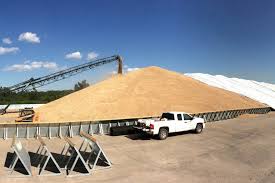
Grain Bunkers add value your already important operation. They are highly cost-effective, provide a high storage solution and are designed to handle large quantities of grain. Grain Bunkers work on your farm or at your commercial depot.
While rudimentary outdoor grain piles have existed for decades, modern, engineered grain bunkers were pioneered in Australia in the 1940s. They were developed during World War II to handle massive wheat surpluses when shipping blockades caused a severe shortage of traditional, permanent silo storage space.
Pre-engineered, open-air grain bunkers became prominent in South Africa during the late 1990s and 2000s. As agricultural yields surged, grain cooperatives and agribusinesses engineered these temporary, large-scale gantry-bunker systems from scratch to quickly manage seasonal overflow that traditional cement silos could not accommodate.
The modern, engineered bunker storage method was specifically conceptualized to handle millions of bushels safely. While they originally served as temporary, emergency storage, they were so structurally sound that they quickly evolved into permanent bulk-handling mainstays globally.
Keeping up to-date with bunker maintenance will always be important to pro-long the life of your bunker. Knowing and having a relationship with your bunker supplier can be beneficial to longevity support of your operation, whether with Grain Bunkers, Grain Silo’s a combination of both or more. Proper up-keep and maintenance is important to help keep your operation long after retirement.
core components of any grain bunker system
Bunker Pad: An elevated, sloped base constructed above low-lying area’s to ensure natural water drainage.
Side Walls: Low, moveable concrete of prefabricated steel walls that structure the perimeter and contain the grain bulk.
Bunker Tarpaulins: Heavy-duty, UV Stabilized plastic covers that hermetically seal the grain against wind, rain and pests.
top advantages of any grain bunker system
Lower capital cost, meaning it requires a significantly lower initial investment.
Scalable Capacity; Grain Bunkers are built to your scale and can range for 500 to 100 000 metric tons.
Harvest Continuity: Grain bunkers help to minimize field machinery idle time.
Flexibility: Grain Bunkers are made to be relocated and reconfigured.
KEY ENGINEERING DESIGN & OPERATION REQUIREMENTS / CHARACTERISTICS
WATER DRAINAGE: The storage pad must maintain a gradient of at least 0.8% toward the open end to prevent water pooling
DUAL-SIDE ACCESS: Sufficient, all-weather truck access is required on both sides to pull heavy tarps & maneuver loading augers
FOUNDATION: Bunkers require carefully graded and compacted soil (typically a 1% incline for drainage) to ensure water and moisture never pool beneath the grain.
RETAINING WALLS: Temporary or movable concrete retaining walls are erected to form the perimeter boundaries of the bunker.
WEATHER SEALING: The grain is poured over ground sheets, shaped, and hermetically sealed with specialized, heavy-duty tarpaulins or PVC covers.
QUALITY MONITORING: Modern bunker systems frequently integrate wireless sensors to track internal CO2, temperature, and moisture levels to mitigate spoilage risks.
PEST CONTROL: The gastight nature of engineered bunkers allows them to be successfully fumigated (e.g., using phosphine).